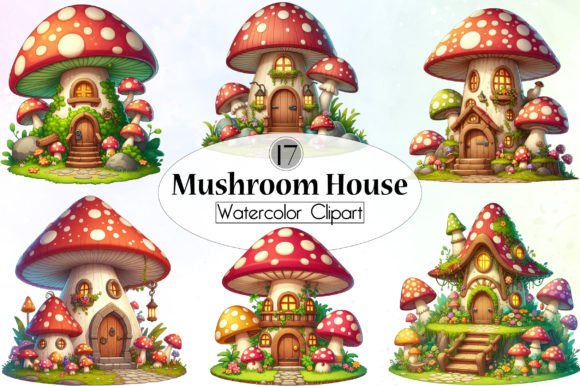
Watercolor Mushroom House Clipart for Creative Projects
You have likely seen it trending across Etsy listings, children’s book mockups, and botanical brand boards. Watercolor Mushroom House Clipart brings a hand-painted, storybook quality to digital and print work that standard vector icons simply cannot replicate. The appeal goes beyond surface-level cuteness. These illustrated scenes combine soft pigment washes, organic brush strokes, and earthy color palettes to evoke nostalgia, whimsy, and a grounded connection to nature. For designers, small business owners, and content creators looking to differentiate their visual identity, this clipart style offers a distinct shortcut to emotional engagement.
What makes Watercolor Mushroom House Clipart so effective is its inherent imperfection. The bleeding edges, variable opacity, and subtle texture of watercolor mimic the tactile experience of real paper and pigment. When you drop one of these illustrations into a layout, it instantly communicates handmade authenticity. That matters more than ever in a marketplace saturated with slick, uniform, AI-generated visuals. People respond to things that feel crafted. A mushroom house rendered in delicate washes of umber, moss green, and muted crimson feels like a tiny world you could step into. It invites curiosity rather than just conveying information.
The Visual Personality of Watercolor Mushroom House Clipart
Let me describe what you are actually getting when you download a quality set. The best Watercolor Mushroom House Clipart collections feature multiple angles and variations: a single capped dwelling with a tiny door nestled in roots, a cluster of houses under a canopy of ferns, and sometimes standalone elements like mushrooms, acorns, toadstools, vines, and woodland creatures. The color palette typically leans toward warm neutrals, forest tones, and soft jewel accents. You rarely see harsh neon or flat fills. Instead, you get layered washes that create depth without hard outlines.
The personality is best described as storybook realism. It is fantastical enough to spark imagination but grounded enough to feel believable. This is not the crisp, geometric flat design you might use for a modern tech brand. It is tactile, organic, and slightly nostalgic. For a crafter making greeting cards or a publisher working on a nature-themed blog, this style signals patience and care. It suggests that someone spent time layering washes and waiting for paint to dry. That perceived effort transfers directly to how your audience perceives your brand.
From a design perspective, Watercolor Mushroom House Clipart functions as a display graphic rather than a background texture. It commands attention. Because of the soft edges and variable density, you typically want to place these illustrations on light, solid backgrounds or within generous white space. They do not compete well with busy patterns or heavy typography. When used correctly, they become the focal point that organizes the entire visual hierarchy around them.
Where Watercolor Mushroom House Clipart Works Best in Practice
I have seen this clipart style deployed across a surprisingly wide range of projects. Here is where it delivers the most impact:
- Children’s book illustration and editorial design. The hand-painted quality aligns naturally with storytelling. A page layout that combines Watercolor Mushroom House Clipart with a clean serif font for the body text creates a warm, readable spread that feels cohesive rather than slapped together.
- Packaging design for artisanal or natural products. Think honey jars, herbal teas, botanical soaps, or mushroom-based supplements. The clipart instantly signals that the product is small-batch, natural, or handcrafted. It elevates simple kraft paper or glass jars without expensive printing techniques.
- Brand identity for nature-focused businesses. A forest school, a botanical garden, a nature therapy practice, or an organic farm can use these illustrations as hero imagery on their website, social media graphics, and printed collateral. The style communicates calm, safety, and a return to simpler things.
- Social media graphics and digital content. On Instagram or Pinterest, flat, static images often get scrolled past. Watercolor textures catch the eye because they look different from the typical Canva template. A quote overlaid on a mushroom house scene can stop the scroll and increase engagement.
- Personal projects and handmade goods. Crafters use this clipart for greeting cards, wall art prints, bullet journal covers, sticker sheets, and scrapbooking. Because watercolor scans well at high resolution, you can print it on matte paper and retain the painted feel.
One observation worth noting: Watercolor Mushroom House Clipart works especially well in vertical and square formats. The organic shape of a mushroom house naturally fills a portrait-oriented frame. A square Instagram post with the house centered and a soft vignette around it feels composed. Horizontal banner layouts can work, but you usually need to pair the clipart with additional elements like vines, foliage, or text blocks to balance the composition.
How This Clipart Influences Brand Perception and Readability
Every design asset you choose carries subtext. When you feature Watercolor Mushroom House Clipart prominently in your brand materials, you are telling your audience several things without saying a word. You are saying that you value craft over speed. You are signaling a connection to nature and a rejection of sterile minimalism. You are inviting people into a story rather than just pitching a product.
For small business owners and entrepreneurs, this is a strategic move. A skincare brand that uses watercolor botanical illustrations immediately feels cleaner and more trustworthy than one relying on glossy stock photography. A children’s activity subscription box that uses these mushroom houses in its email headers and landing pages feels more playful and less corporate. The clipart functions as a brand identity shorthand. It primes the visitor to expect warmth, creativity, and attention to detail.
From a readability and visual hierarchy perspective, watercolor clipart requires thoughtful placement. Because the edges are soft and the interior has variable opacity, you do not want to put body text directly over the painted areas. You lose contrast and legibility. Instead, use the clipart as an anchoring element. Place it on the left or right side of a layout, let it bleed off the edge for a modern look, or use it as a background wash with text overlaid in a darker, solid area. Many designers create a duotone effect by converting the clipart to a lighter opacity and using it as a subtle backdrop for headers. That approach preserves the watercolor texture while maintaining readability.
Consistency matters here. If you use Watercolor Mushroom House Clipart on your homepage and social media but then switch to flat vector icons on your product pages, the visual dissonance undermines brand recognition. Your audience may not articulate it, but they will feel the shift. Treat the clipart as a core design asset, not a decorative afterthought. Build your color palette, typography, and layout grid around it.
Practical Guidance for Choosing and Using Watercolor Mushroom House Clipart
Not every set on the market is created equal. Here is how to evaluate whether a specific collection will serve your project well.
Start with the resolution and file format. A quality Watercolor Mushroom House Clipart set should include high-resolution PNG files with transparent backgrounds. You want at least 300 DPI for print projects and a minimum of 2000 pixels on the longest side for digital use. If the images look pixelated when you zoom in, they will not hold up in print. Check whether the set includes both color and black-and-white versions. Some illustrators also include layered PSD or TIFF files, which give you more control over color adjustments.
Evaluate the color palette. The best sets have a cohesive but not identical range. Look for warm browns, muted greens, soft blues, and gentle reds. Avoid sets where every piece uses the exact same saturation or hue. Variety within a controlled palette gives you flexibility to pair the clipart with different brand colors without clashing. If you run a brand with a specific color system, test the clipart against your primary and secondary colors before purchasing.
Consider the style consistency. All the illustrations in a single set should look like they were painted by the same hand. The brush texture should be uniform. The level of detail should be similar across pieces. A set where one mushroom house is highly detailed and another is a rough sketch will be difficult to use together in a single layout.
Test font pairings early. Watercolor clipart pairs best with fonts that do not compete for attention. A clean sans serif font like a soft geometric or a humanist sans works well for headers. For body text, a neutral serif font with good readability at small sizes is ideal. Avoid script fonts that mimic handwriting, as they can clash with the painted texture and make the overall look feel busy. You want the typography to support the clipart, not wrestle with it.
Read the commercial license carefully. If you are a small business owner or entrepreneur, you need a license that covers commercial use. Many Watercolor Mushroom House Clipart sets come with a standard license that allows you to use the images in products you sell, such as printables, greeting cards, or digital downloads. Some restrict use in logo design or require attribution. If you plan to use the clipart as part of a brand identity or logo, confirm that the license explicitly permits that. A few premium sets offer extended licenses for merchandise, app development, or large-scale print runs. Do not assume that a purchase automatically includes full commercial rights.
Finally, test before you commit. Download a sample file if the seller provides one. Place it into your design software and mock up a realistic layout. Does the clipart hold its presence at the size you need? Does it clash with your existing design assets? Does it evoke the emotional response you want? A one-minute test can save you from buying an entire set that does not fit your workflow.
Watercolor Mushroom House Clipart is more than a decorative asset. It is a visual strategy. Used intentionally, it builds brand recognition, signals authenticity, and creates an emotional bridge between your work and your audience. Whether you are designing a logo, building a social media presence, or crafting a product line, this style offers a distinctive, human-centered alternative to the generic visuals that dominate most markets. Treat it as a core part of your toolkit, choose your set carefully, and let the imperfect beauty of watercolor do the work that polished vectors never can.